
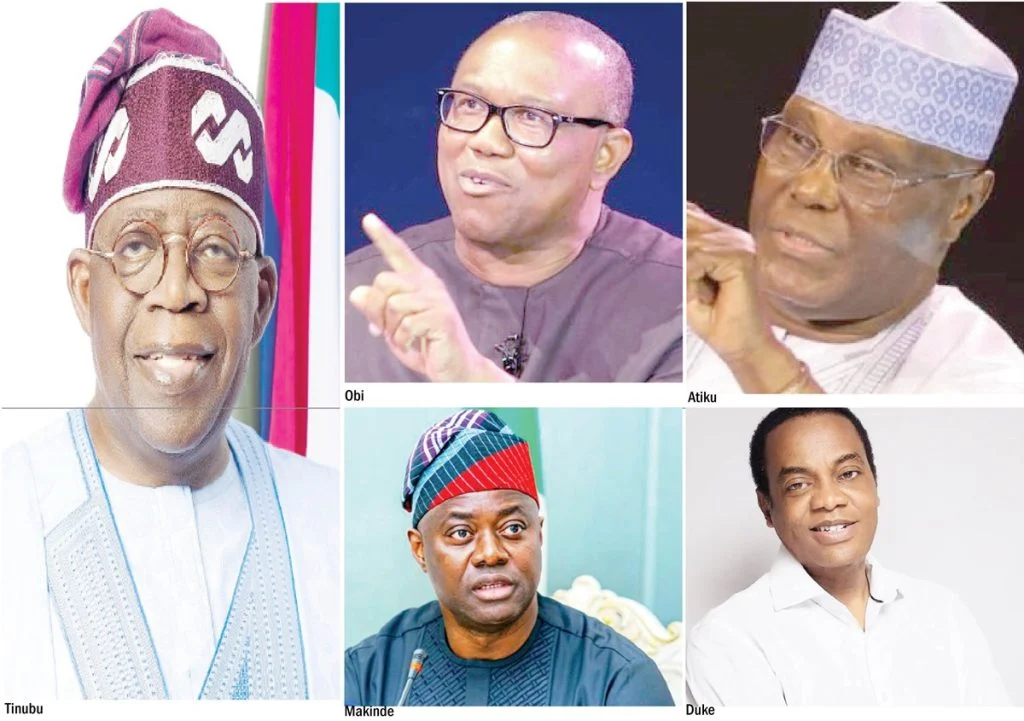
In exactly six months’ time, Nigerians will file out in their millions to elect a president for the nation. The political horse trading, permutations and calculations that have dominated the country’s political landscape have become more intensified as the various political parties have unveiled their presidential candidates. In this report, JOSEPH ABASI-ABASI (CROSS RIVER), ALPHONSUS AGBORH (DELTA), OLAWALE SANUSI (RIVERS STATE) and IDAHOSA MOSES (EDO), take a look at the chances of the political parties and their candidates in the South-South geo-political zone.
The emergence of Senator Sandy Onor as the (PDP) Peoples Democratic Party’s presidential candidate places Cross River State at the centre of national politics.
A seasoned politician and one of the state’s most recognisable opposition figures, Onor’s candidacy presents the PDP with an opportunity to rebuild its fortunes in a state now firmly under APC control.
The immediate question, however, is whether his popularity can translate into electoral victory in his home state and the wider South-South.
Strong Home Advantage
Onor enters the race with significant political assets. As a former senator representing Cross River Central and the PDP’s governorship candidate in 2023, he has built an extensive political network across the state. His strongest base remains the Cross River Central Senatorial District, particularly Yakurr, Obubra, Abi, Ikom, Etung and Boki Local Government Areas, where the PDP has recently recorded high-profile defections from the APC.
These defections suggest the opposition is gradually rebuilding structures that got weakened after losing power in the state.
Beyond the Central District, Onor is expected to attract sympathy votes as the first major presidential candidate from Cross River in recent political history, a factor that could energise many voters irrespective of party affiliations.
The above notwithstanding, the biggest question to ask is: Can Regional Sentiment Help?
The South-South, since the beginning of this present political dispensation in 1999, has traditionally supported the PDP in presidential elections, although the APC has made significant inroads in states such as Cross River and Edo.
Onor’s emergence could revive conversations around regional representation, with many political observers expecting some voters to rally behind a candidate from the region. However, regional sentiment alone may not be sufficient.
Voting behaviour is increasingly shaped by economic realities, security concerns, party structures and candidate appeal rather than geography alone.
APC Still Holds the Advantage
Despite the PDP’s renewed momentum, the APC remains the dominant political force in Cross River.
Governor Bassey Otu controls the state government, while the party enjoys incumbency, established grassroots structures across the 18 local government areas and considerable mobilisation capacity. The APC is also expected to leverage ongoing infrastructure projects, agricultural programmes, tourism initiatives and social interventions as campaign achievements.
Unless the PDP significantly expands beyond its traditional support base, overcoming these structural advantages will remain difficult.
PDP’s Biggest Test
For the PDP, recent defections from the ruling APC and other political parties to the PDP are encouraging but not decisive. There are lots of challenges the party must overcome for it to make any meaningful impact. For instance, the party must convert political rallies into functioning ward structures, reconcile old and new members and sustain momentum until the election.
It also needs to penetrate areas where the APC currently enjoys overwhelming support, particularly in parts of the Northern and Southern Senatorial Districts. Onor’s ability to unite different interests within the party could become one of his greatest strengths in the months leading to the 2027 general election. Even at that, there still remains the question of national acceptability and popularity.
National Challenge
While Onor may enjoy considerable support within Cross River and parts of the South-South, winning Nigeria’s presidency requires broad national acceptance.
Under the constitution, a presidential candidate must secure not only the highest number of votes nationwide but also at least 25 percent of votes in no less than two-thirds of the states making up the Federation and the Federal Capital Territory (FCT), Abuja.
This means his campaign would need to build strong alliances and gain substantial support across the North, South-West, South-East and other geopolitical zones.
An assessment of the electoral prospects of the major political parties must be viewed against the backdrop of the state’s evolving political landscape, recent realignments, party structures, and prevailing socio-economic realities.
While political dynamics could shift considerably before the polls, any analysis on the political trend in the oil-rich state must reflect the current balance of forces without being projected as a definitive prediction.
President Bola Tinubu (APC)
President Tinubu, gunning to retain his seat, enters the race with significant political advantages in Rivers State and has been seen to stand a better chance to win.
A major factor is the influence of the Minister of the Federal Capital Territory (FCT), Nyesom Wike, whose political structure remains one of the most formidable in the state. Wike played a key role in President Tinubu’s victory in Rivers State during the 2023 presidential election and continues to command considerable grassroots support. He commands the 23 local government areas structures; he also commands strong grassroots political machinery, the Grassroots Development Initiative (GDI) that will do everything possible for President Tinubu to be re-elected in 2027.
GDI is a political pressure group established around 2012 to mobilise grassroots support for the governorship ambition of Nyesom Wike. It grew into one of the most influential political organisations in Rivers State, with structures across all 23 local government areas.
Another important development is the formation of the Rainbow Coalition under the Renewed Hope Family. The coalition was initiated by Wike to mobilise support for Tinubu’s re-election and coordinate candidates for elective offices across Rivers State.
Reports indicate that the coalition includes members drawn from the APC, PDP, LP and Action Alliance (AA). However, the alliance has generated controversy.
The Inter-Party Advisory Council (IPAC) has stated that there is no officially recognised Rainbow Coalition of political parties in Rivers State. In addition, sections of the Labour Party have publicly distanced themselves from the coalition, insisting they are not part of the political arrangement.
Despite these disagreements, the combination of incumbency and Wike’s political influence could strengthen Tinubu’s electoral prospects in Rivers State.
Atiku Abubakar (ADC)
Former Vice President Atiku Abubakar remains one of the leading opposition figures with considerable political appeal in Rivers State.
His previous electoral performances have benefited significantly from his political alliance with former Rivers State Governor Rotimi Amaechi, whose support base remains influential across several local government areas.
With Amaechi actively participating in Atiku’s campaign as the vice presidential candidate, the ADC could emerge as a formidable challenger to the APC in Rivers.
However, recent legal developments present challenges for the party.
On July 13, 2026, the Court of Appeal affirmed an earlier Federal High Court judgment restraining the Independent National Electoral Commission (INEC) from recognising state congresses conducted by the David Mark-led leadership of the ADC.
The appellate court, in a split decision, upheld the ruling that the existing state executives remain in office pending properly constituted congresses and a national convention.
While the judgment primarily concerns the party’s internal leadership and organisational structure rather than its eligibility to contest elections, prolonged uncertainty over party administration could affect mobilisation, candidate coordination and campaign organisation in Rivers State if unresolved.
Peter Obi (NDC)
Former Anambra State Governor, Peter Obi, continues to enjoy significant popularity among many Rivers State voters.
In the 2023 presidential election, Obi finished second in Rivers State after polling 175,071 votes behind Bola Tinubu’s 231,591 votes. His performance demonstrated a strong electoral base despite limited traditional political structures in the state.
Many political observers believe Obi’s popularity remains intact, particularly among young voters and urban residents.
However, questions remain about organisational strength at the grassroots level. Political popularity does not always translate into electoral victory, especially in a state where established political structures, local alliances and election-day mobilisation often play decisive roles.
If the NDC develops a robust grassroots network and secures the backing of influential political stakeholders across Rivers State, Obi’s chances could improve considerably. Conversely, if organisational weaknesses persist, the structural challenges that affected his 2023 campaign may again become a significant factor.
General Outlook
As the 2027 election approaches, Rivers State is shaping up to be one of Nigeria’s most competitive political battlegrounds.
President Tinubu appears to benefit from the combined advantages of incumbency and the political machinery associated with Nyesom Wike.
Atiku Abubakar’s prospects may depend largely on the ADC’s ability to resolve its internal legal and organisational issues while effectively leveraging the influence of Rotimi Amaechi and other opposition figures.
Peter Obi continues to command significant public goodwill, but his electoral prospects may hinge on whether the NDC can build a stronger grassroots political structure capable of converting popular support into votes.
Ultimately, the outcome in Rivers State will likely be determined by a combination of party organisation, candidate selection, campaign strategy, voter turnout, and the ability of each camp to consolidate alliances before election day.
2027: A four-way contest, big promises and the battle for the ballot in Edo
As the countdown to the 2027 presidential election gathers momentum, Edo State is emerging as one of Nigeria’s most strategic electoral battlegrounds. With no presidential candidate from the state, the contest is expected to be driven more by issues of governance, party organisation and voter mobilisation than by ethnic considerations.
While President Bola Ahmed Tinubu of the APC and Peter Obi of the NDC are widely viewed as the leading contenders, the Peoples Democratic Party (PDP) and the African People’s Movement (APM) could also shape the outcome, depending on how events unfold before the election.
The political landscape in Edo changed significantly with the election of Governor Monday Okpebholo and the return of the APC to power in the state. With the APC controlling both the Federal Government and the Edo State Government, the ruling party enjoys the advantages of incumbency, an extensive grassroots structure, access to experienced campaign machinery and greater mobilisation capacity. These advantages have historically been important in Nigerian elections, although they have never guaranteed victory.
Governor Okpebholo further heightened political expectations when he declared that he would deliver 3.5 million votes for President Tinubu in the 2027 election. The declaration immediately generated public debate. To APC supporters, it symbolises confidence in the party’s growing influence, while critics regard it as an ambitious political target intended to motivate party faithful rather than a projection based on existing electoral realities.
Whether that promise can become reality remains a major question. Based on Edo State’s voter register and historical voting patterns, delivering such a figure would require a substantial increase in voter registration and an unprecedented turnout. Unless there is a significant expansion of the voting population before the election, many observers are likely to see the promise as political optimism rather than a realistic electoral projection.
For the APC, however, the road to victory extends beyond political promises. The party’s chances will depend largely on the performance of the Tinubu administration before 2027. If there are measurable improvements in economic stability, security, infrastructure, electricity supply, employment opportunities and the cost of living, the APC could consolidate its support. At the same time, internal unity and effective grassroots mobilisation will remain critical.
Peter Obi remains one of the APC’s strongest challengers in Edo. His impressive showing in the 2023 presidential election established a loyal support base that continues to resonate with many young voters, professionals, civil society groups and urban residents. His popularity has largely been sustained through organic support rather than traditional political patronage, making him a formidable opponent despite the APC’s structural advantages.
Obi’s alliance with Rabiu Musa Kwankwaso as his running mate could further strengthen the NDC ticket and chances in Edo State. While Kwankwaso’s greatest electoral influence lies in Northern Nigeria, his national political profile and the Kwankwasiyya Movement could broaden the ticket’s appeal and reinforce perceptions of national balance. If effectively managed, the alliance could help the NDC attract voters looking for an alternative to the two dominant parties.
The PDP’s chances present perhaps the greatest uncertainty. The party remains one of Nigeria’s most established political platforms and still commands loyal supporters and experienced political operators across Edo State. However, its internal leadership crisis and the legal disputes surrounding the party’s structure could significantly weaken its prospects.
If the courts eventually clear the PDP to participate with a united leadership and a widely accepted presidential candidate, it cannot be dismissed, as it retains a recognisable brand and functioning grassroots network. On the other hand, if the crisis persists or produces prolonged litigation, the party may struggle to run an effective campaign, and many of its supporters could drift towards either the APC or the NDC.
The African Democratic Congress (ADC) has also emerged as a party to watch, particularly its success in consolidating the coalition of opposition politicians seeking an alternative platform ahead of the 2027 election. Although the ADC has traditionally maintained only a modest electoral presence in Edo State, the entry of prominent national political figures into the party has significantly raised its profile. If the coalition remains united and a litigation-free candidate, the ADC could attract protest votes, disenchanted supporters of the APC and PDP, as well as voters seeking a fresh political direction.
In Edo State, however, the ADC’s prospects will depend largely on how quickly it can strengthen its grassroots structures across the 18 local government areas and convert national momentum into local electoral support. The party will also need to avoid internal divisions that have weakened many opposition alliances in the past.
While it may not begin the race as the favourite, a well-organised campaign backed by credible candidates and effective mobilisation could make the ADC a serious contender, capable of reshaping the electoral landscape and reducing the dominance of the traditional major parties.
The African People’s Movement (APM) is unlikely to begin the race as a frontrunner, but it would be premature to dismiss its chances entirely. Nigerian elections have shown that smaller parties can influence outcomes by attracting protest votes, dissatisfied members of larger parties and independent-minded voters.
Should the APM present a credible presidential candidate, build a disciplined campaign and capitalise on divisions within the APC, NDC or PDP, it could improve its electoral relevance. Even if it does not win Edo, its performance could affect the margin separating the leading contenders.
Edo has consistently demonstrated an independent voting culture. The electorate has repeatedly shown a willingness to vote across party lines whenever it believes a candidate best represents its interests. That political tradition makes the state one of Nigeria’s most unpredictable electoral battlegrounds and suggests that incumbency, popularity or political declarations alone will not determine the final outcome.
Ultimately, the 2027 presidential election in Edo will be decided by the electorate rather than campaign rhetoric. Governor Monday Okpebholo’s promise of delivering 3.5 million votes for President Tinubu remains an ambitious political objective that must withstand the test of electoral reality.
Peter Obi must convert his popularity into votes through effective organisation and mobilisation. The PDP’s fortunes will depend largely on whether it resolves its internal crisis and remains a viable electoral force.
The ADC’s success will rest on its ability to sustain its coalition, build strong grassroots structures, translate national momentum into votes, and its resolution of its internal crisis, while the APM’s ability to expand beyond the role of a minor party could also influence the overall contest. In the final analysis, the strength of party structures, voter turnout, economic conditions, candidate credibility and campaign strategy, not political promises, will determine who wins Edo State in 2027.